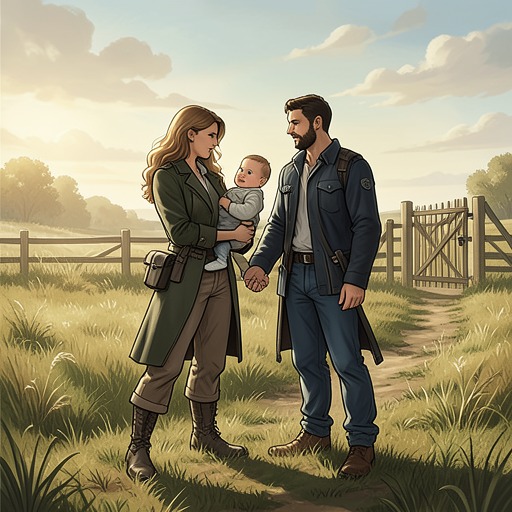
Family doesn't get left behind
A Werewolf Thing: A Rejected Mate Werewolf Romance“Family doesn't get left behind” is both a declaration and a governing ethic in Saphira’s story. Spoken when Sondra is being held by Banshees, the expression converts family from a sentiment into a command: kinship requires action, even when rescue is dangerous. Its meaning then reverberates through the wider narrative in scenes of injury, pregnancy, twin connection, mate-bonded care, and the ordinary persistence of family life after crisis.
Meaning and First Dramatic Use
Saphira states the principle while preparing to recover Sondra. She identifies Sondra specifically as her cousin and family, then rejects the possibility that family can be abandoned or left in the hands of “mean Banshees.” The wording gives the rescue a moral clarity that exceeds tactical planning. Saphira and Trevor are not merely responding to an attack; they are accepting an obligation created by kinship.
The expression also establishes the standard by which the scene’s choices are judged. Saphira acknowledges that the plan is risky, but risk does not cancel responsibility. When Trevor asks for the plan through the pack mind link, Saphira answers that they will get Sondra back “at any cost.” The sequence therefore moves from principle to decision and from decision to coordinated action: Saphira and Trevor communicate silently, Trevor advances, and he tackles the Banshee, causing Sondra to fall from his shoulder.
Family as Action Under Threat
The rescue scene gives the expression its strongest literal force. Sondra’s abduction places family in the position of a vulnerable person who must be retrieved, while the Banshees function as the immediate force trying to separate her from those who claim responsibility for her. Saphira’s response is not passive grief or delayed retaliation. She recognizes the danger, forms a plan with Trevor, and acts before the separation becomes permanent.
Trevor’s participation is important because the principle is enacted collectively. Saphira does not treat family loyalty as an isolated feeling belonging only to the person who speaks. Through the pack mind link, she and Trevor become a rescue unit. His tackle is the physical culmination of her ethical decision, making the phrase a compact statement of shared courage, mutual reliance, and refusal to accept abduction as an ending.
Care, Protection, and Bodily Connection
Elsewhere, the same idea appears through care rather than combat. Saphira’s twin bond with Trevor means that each can sense when the other is distressed, and physical injury to one is felt by the other. This connection makes family responsibility unusually embodied: Trevor’s suffering is not distant information to Saphira, and her pain is not private from him. The bond turns concern into an involuntary form of shared experience.
That protective ethic becomes medically charged when a doctor tells Ashton that the arrow that struck Saphira was coated in poison. The disclosure transforms an injury into a life-threatening crisis and prompts Ashton’s shocked reaction. Later, Saphira begs Carmen for more than five minutes to allow her an hour alone with Trevor while he lies limp, pale, and visibly struggling beneath his eyelids. Carmen has not slept and is barely eating, so the scene presents care as exhausting work shared among relatives and companions rather than as a simple romantic gesture.
Protection, however, can also become a conflict over agency. When Trevor warns Saphira that she is pregnant and therefore cannot lead an army, he frames nonparticipation as protection for both her and the unborn child. Saphira rejects the restriction by pointing to her half-faery identity and her ability to cast a protective charm on herself. The family ethic thus has two competing forms: standing beside a loved one in danger and attempting to keep that loved one out of danger. The expression supports loyalty, but it does not settle who gets to decide what loyalty requires.
From Crisis to Household
The principle finally extends beyond rescue into reunion and domestic continuity. When Ashton approaches Saphira, she moves toward him and throws herself into his arms; he holds her carefully around her stomach, and she tells him that she missed him. The gesture joins emotional reunion with physical caution, showing affection adjusted to pregnancy rather than separated from it.
A later exchange with a child also places the phrase within an intergenerational household. Saphira tells a girl that a future mate may hold high rank and that she might become a Luna, only for Ashton to dismiss the girl’s expectation from the doorway. Clayton then runs to Saphira calling for his mother, and she bends to pick him up. The scene undercuts formal speculation about rank with the immediate fact of family recognition: titles and mate arrangements matter, but a child’s attachment and a mother’s response are the most direct expressions of belonging.
Narrative Significance
“Family doesn't get left behind” operates as a recurring moral lens rather than merely a memorable line. It explains why Saphira accepts danger for Sondra, why Trevor’s rescue of a relative becomes a shared mission, why twin pain carries ethical weight, and why scenes of poisoning, coma, pregnancy, reunion, and childcare remain connected despite their different circumstances.
The expression also broadens the story’s definition of family. It includes a cousin endangered by Banshees, a twin joined through a painful bond, a mate whose protection can become restrictive, a caregiver who endures sleeplessness, and a child who seeks his mother. In each case, family is proven through presence and response. The phrase’s decisive force lies in its refusal to treat separation as neutral: when someone belongs to the family, leaving that person behind becomes an unacceptable moral failure rather than a mere plot outcome.